
Emergency Gate Repair Near Me: What Ventura Homeowners Should Do First
The most common way a jammed gate becomes an expensive gate is a homeowner standing in the driveway pressing the remote over and over while something is clearly blocking the path. Force plus obstruction equals mechanical damage every time – a bent operator arm, a stressed limit switch, a stripped gear. The fix that would have taken an hour turns into a half-day job. So before anything else: stop pressing the button. What you do in the first five minutes in Ventura decides whether this is a quick reset or a real repair.
If you’d rather not work through it yourself, call (833) 361-4971. We answer 24/7. Fast dispatch from 7am to 7pm, Sunday through Friday.
What Should You Check First When Your Gate Stops Working?
Check three things in this exact order: obstruction, manual release, then power. Order matters because each check tells you whether the next one is even worth doing, and because doing them out of sequence is how people damage equipment that was only temporarily confused.
- Obstruction. Walk the full travel path of the gate. Look for a fallen branch, a dropped toy, a recycling bin nudged into the arc, a warped board, a driveway slope that’s shifted with the seasons. Many operators – Viking and Ghost Controls residential units among them – have built-in obstruction sensing and will simply refuse to move. Clearing the path and re-engaging often solves it outright.
- Manual release. Locate the release before you touch power. Every automated gate has one, and knowing where it is tells you whether you can move the gate by hand to clear a stuck vehicle or restore access. Don’t pull it yet if the gate is on a slope – more on that below.
- Power at the operator. Confirm the control board has power. A tripped breaker, a GFCI that popped, or a control transformer that’s failed will all present as a dead gate. This is a visual check only. Don’t open the operator housing and start probing wiring – the low-voltage control side still shares a box with line voltage, and that’s a job for someone trained on it.
Run those three in order and you’ll either have a working gate or a clear description of what’s wrong. Either way you’re ahead. Gate-only specialists in Ventura diagnose faster when the homeowner can say “obstruction is clear, release works, no power at the board” instead of “it just stopped.”
How Do You Open a Gate Manually When the Operator Fails?
Every automated gate – swing, slide, or overhead – has a manual release, and using it correctly is what keeps you from voiding the operator warranty or straining the mechanism. The principle is the same across types: disengage the operator from the gate, move the gate by hand, secure it. The details differ.
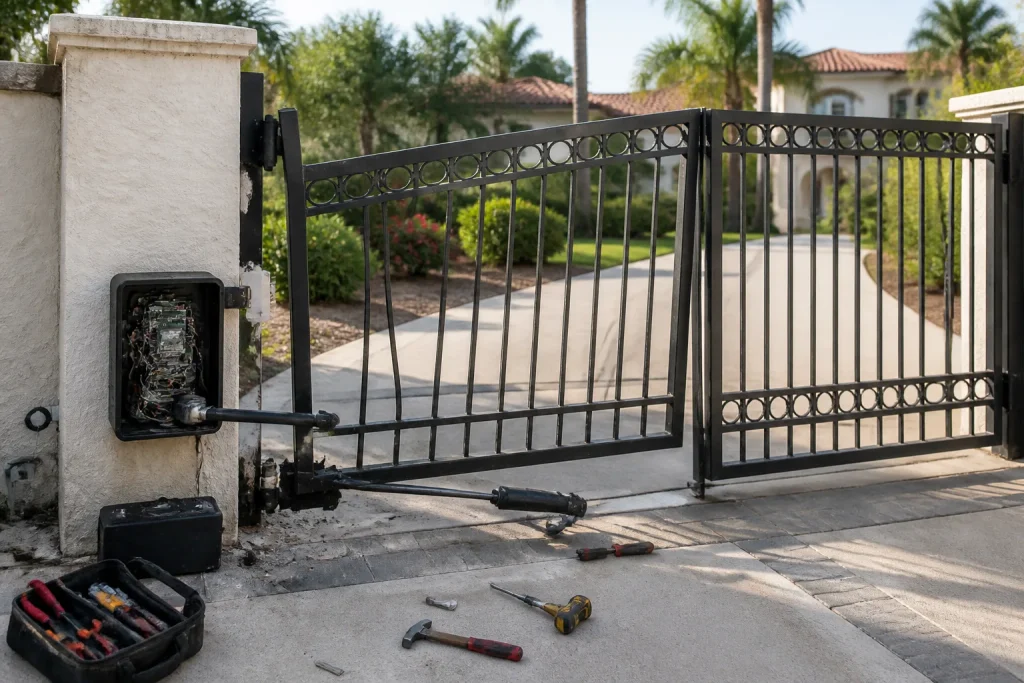
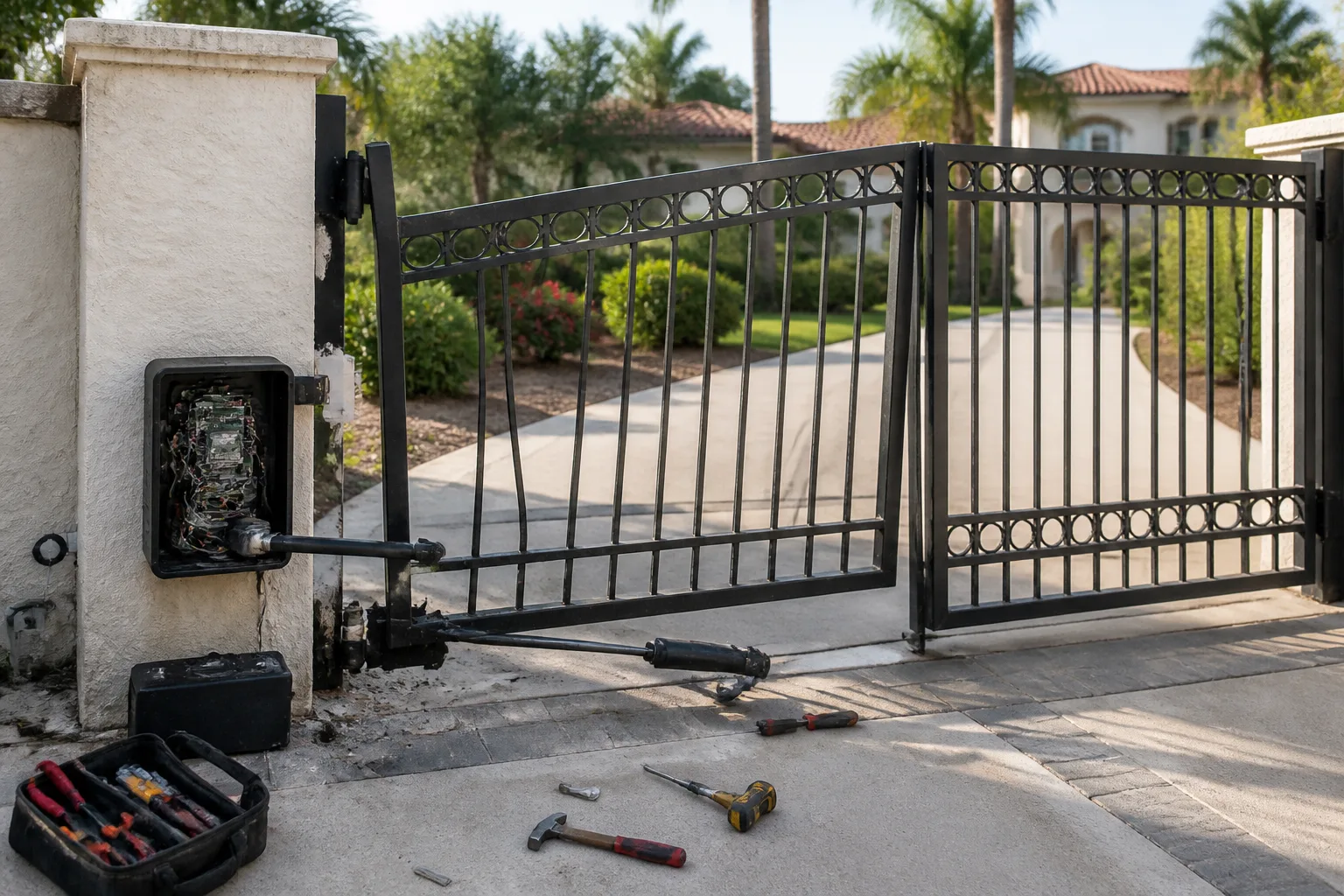
- Swing gates. Release levers are usually on the operator arm or the motor housing. Once disengaged, the gate should swing freely by hand. If it binds, stop – something mechanical is wrong and forcing it causes more damage.
- Slide gates. The release disengages the pinion from the rack. Before you pull it, know that a slide gate on any grade can roll once released. Have a chock or a person ready to control it. Same rule if the gate has come off its track – that’s a heavy panel and a genuine crush hazard.
- Overhead gates. Follow the release procedure for your specific operator. Overhead mechanisms carry more stored energy than swing or slide, and the counterbalance and track hardware deserve respect. If the release won’t engage cleanly, leave it and call.
Two rules that apply to all three. First, never leave a gate released and unsecured overnight if it’s your security line – chock it, pin it, or prop it deliberately. Second, once the operator is repaired, the release must be re-engaged properly. A gate that looks fine but isn’t actually latched to the operator will fail again within days. We work on your brand, from residential Ghost Controls and Mighty Mule units to commercial DoorKing and FAAC operators, and the release procedure is the first thing we confirm on arrival.
What Should You Tell the Repair Technician When You Call?
Four pieces of information let a gate specialist arrive prepared instead of diagnosing cold. That’s the difference between a first-visit fix and a second appointment while someone tracks down the right control board.
- The brand. Operator name and model if you can find it – on the housing, the control box, or the manual. Viking, Elite, Linear, LiftMaster, BFT, Mighty Mule: knowing the brand tells us which control architecture and release system we’re walking into.
- The symptom. Be specific. “Gate opens but won’t close” is very different from “nothing happens” is very different from “it moves a foot and reverses.” Each points to a different subsystem – safety loops, limit switches, control board, motor.
- The last normal behavior. What was the gate doing the last time it worked correctly? Did it slow down gradually? Did the remote range shrink? Did it start reversing intermittently? Degradation patterns point straight to the failing part.
- Anything unusual. Recent storm, a bumped post, a new car parked near the safety loop, a power flicker, a gate that’s been “a little stiff” for a week. Small details save diagnostic time.
One more: tell us if the gate is blocking emergency vehicle access or a vehicle is trapped. Those change how we prioritize the call. For everything else, the written estimate sets the price before any work begins – you’ll know the number before we touch the gate.
Which Gate Problems Are Real Emergencies in Ventura?
Not every failed gate is an emergency, and treating a routine fault like a crisis can push it to the back of the queue while genuine emergencies get handled first. Here’s the honest split.
True emergencies – call now:
- A gate closed on a vehicle, or a vehicle trapped inside or outside the gate line.
- A gate blocking emergency vehicle access or a shared driveway others can’t use.
- A gate that won’t secure overnight when it’s your property’s only barrier – commercial properties, HOAs, and security-sensitive residences.
- Any situation where the gate is in motion and won’t stop, or where a panel or track has failed in a way that’s unsafe to approach.
Can usually wait until the next dispatch window:
- A gate stuck open on a property with other security measures in place.
- A remote that’s stopped working while the gate still operates from a keypad or interior control.
- Intermittent reversing, slowdowns, or a gate that works “most of the time.”
- Cosmetic damage, a gate that’s stiff but functional, or one that needs adjustment rather than repair.
If you’re unsure which side you’re on, call and describe it. We answer 24/7. A call outside dispatch hours is booked into the next opening, Sunday through Friday, 7am to 7pm. We’re closed Saturday.
Why Do “Emergency Gate Repair Near Me” Searches Return Garage-Door Companies?
Because most companies that show up in a Ventura search for gate repair are garage-door outfits that added gates as a side service. They’ll take the call, but the technician may be working from a manual on the hood of the truck, guessing at control-board logic they don’t see every day. Gates are all we do, and that’s the whole difference.
When you call a gate company, listen for these signals:
- They ask for the brand first. A specialist wants to know if you’re running Ghost Controls, DoorKing, Elite, Viking, FAAC, or something else before they roll. We work on your brand, and we’re familiar with nine of the leading operator lines across residential, commercial, and HOA-grade systems.
- They ask about the symptom and last normal behavior. A generalist asks “what’s wrong?” A specialist asks what it was doing before it stopped.
- They know the difference between a mechanical fault and a control fault. Operator arm, limit switch, control board, safety loop, wiring, motor – the diagnosis should sound like it’s coming from someone who works on these daily.
- They handle both automated and manual gates. If the operator is failed, the mechanical gate still has to work. A single-source gate company covers both.
Our technicians have up to 8 years of experience on gate systems specifically – not split across a dozen trades. That’s why we can talk through the motor to the motor arm without a manual. For a full rundown of what we cover, see our gate repair services, or if the issue is electrical, our electric gate repair page walks through operator, control-board, and safety-loop troubleshooting.
When to Call a Pro
Call a professional when the fault is in the operator’s wiring or power, when a panel is heavy enough to be a crush hazard, when a slide gate has come off its track, or when your three-step first check didn’t resolve the issue. Don’t open the operator housing or probe line voltage yourself. Safety edges, safety loops, and control logic are all part of the same system, and a confident amateur can turn a control-board fault into a full-operator replacement faster than you’d think. That’s not a scare tactic – it’s a pattern we see. The free estimate and the written price before work starts mean there’s no reason to gamble on it.
Related services in Ventura: if you’re weighing a repair against a new gate, or you’re ready for a full installation, we cover the entire arc – diagnosis, repair, and brand-new gate installation – so you don’t need a second company when your needs change. Residential or commercial, automated or manual, it’s one call. Start at Ventura Gate Repair or learn more about our Ventura coverage.
The Bottom Line
The first five minutes decide the day. Clear the obstruction, find and understand your manual release, check power at the operator – in that order. Then gather four facts for the call: brand, symptom, last normal behavior, anything unusual. That’s what lets a gate specialist arrive ready instead of diagnosing cold.
If the gate is on a vehicle, blocking emergency access, or leaving your property unsecured overnight, treat it as an emergency. If it’s stuck open with other security in place, it can usually wait for the next dispatch window. Either way, a specialist beats a guess every time.
If you’re in Ventura and need help, Ventura Gate Repair offers free estimates – call (833) 361-4971. We answer 24/7. Fast dispatch from 7am to 7pm, Sunday through Friday.
Frequently Asked Questions
Yes – for genuine emergencies like a gate closed on a vehicle or a gate blocking emergency access, we fast-dispatch from 7am to 7pm, Sunday through Friday. Call (833) 361-4971, describe the situation, and we’ll book the earliest opening. We answer 24/7.
Only if the gate is still moving and won’t stop. A gate that’s simply stopped doesn’t need the power cut, and flipping the breaker repeatedly won’t fix a control-board or limit-switch fault – it just resets the symptom. Clear the obstruction, check power at the operator visually, and call.
We work on your brand – nine of the leading operator lines, including LiftMaster, FAAC, BFT, Linear, Viking, Ghost Controls, DoorKing, Elite, and Mighty Mule. That covers residential-grade units and heavy-duty commercial operators, so whether it’s a Ghost Controls driveway gate or a DoorKing access system, we arrive knowing the architecture.
Not when it’s used as designed. The manual release exists for exactly this situation. What can cause problems is forcing a bound gate, pulling the release on a slide gate without controlling it on a slope, or failing to re-engage the operator properly afterward. When in doubt, call and we’ll walk you through it.
Written by the team at Ventura Gate Repair.
Need Gate Repair Help?
Call Ventura Gate Repair - licensed & insured, here with fast help in Ventura.
(833) 361-4971